Contents
This page will discuss flowering plants. These organisms are composed of an underground root system and an overground shoot system.
ROOTS
TAP ROOTS
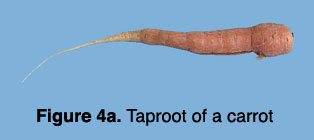
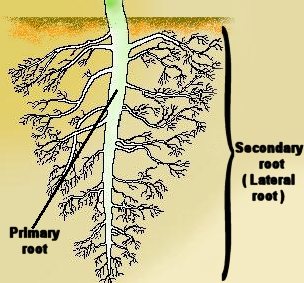
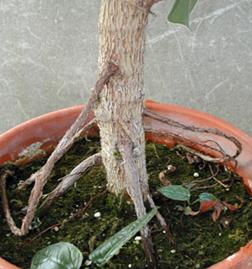
Taproots develop from the initial root that emerges from the seed. This was called the radicle. This is also called the primary root. These roots are present in most dicots.
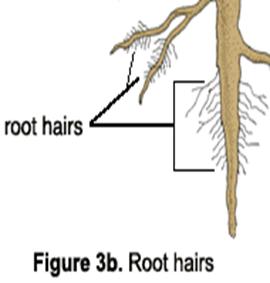
A lateral root, also called a secondary root is a side branch of the main root. The tips of these roots are covered with tiny root hairs.
FIBROUS ROOTS
Most monocots have a fibrous root system consisting of an extensive mass of similarly sized roots. In these plants, the radicle is short lived and is replaced by a mass of equal sized roots. These roots are most common in monocots.

ADVENTITIOUS ROOTS
These are roots that do not grow from the radicle. They grow from various areas of the plant.
FUNCTIONS OF ROOTS
Roots anchor the plant in the soil.
Roots absorb water and mineral salts from the soil through their root hairs.
Roots may store food. (carrots , turnips, radishes)
Roots form a passageway for water and dissolved substances from the root into the stem and also for foods from the stem down into the root.
THE ZONES OF A ROOT
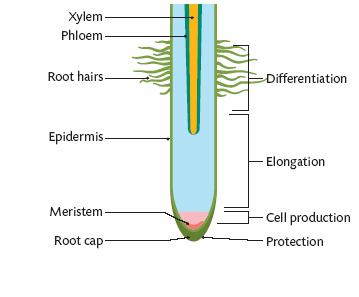
Zone of protection also known as the Root Cap: envelope that protects the root as it pushes through the soil.
Meristem: tissue at the tip of the root composed of rapidly multiplying cells. Meristem tissue is found in many areas of the plant. These are all tissues that have rapidly dividing cells for cell growth.
Elongation zone: set of cells that determine the growth of the root. This area is where plant growth regulators, such as auxins, stimulate the cells from the meristem to grow larger.
Zone of Differentiation: This is the area where the elongated cells develop into different types of tissues. These types are:
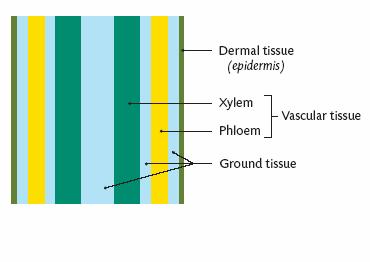
Dermal tissue- such as epidermis that protects the plant.
Ground tissue- tissue found between the dermal and vascular tissue. Serves as structural strength.
Vascular tissue- tissue that transports material. Xylem transports water and phloem transports food.
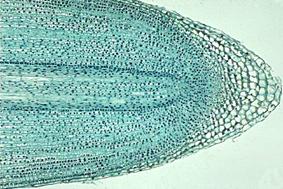
Root tip:
STEMS
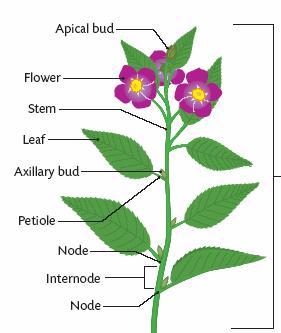
The stem is the main part of the shoot:
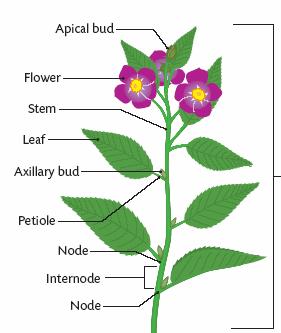
Branch: a side stem that developed from an axillary bud.
Petiole: leaf stalk – not always present.
Node: the point of origin of a leaf on a stem.
Internode: the section of stem between two successive internodes.
Axil: the angle between the upper side of a leaf and its stem.
Axillary Bud: will develop into a side branch or flower.
Apical or Terminal Bud: increase in length of the stem forming new leaves and axillary buds.
Lenticels: loose open cork tissue for gas exchange for efficient aerobic respiration.
Function of Stems
Formation of buds, leaves and flowers.
Supports leaves in good light conditions to maximise photosynthesis.
Vegetative reproduction e.g. stem tuber of potato
Food storage e.g. stem tuber of potato.
If you like flowers and are ever in the Seattle area, check out the Heronswood Gardens in the state of Washington.
Visit EcosystemGardening for amazing planting tips that are eco-friendly!
Find more gardening tips at the The Fun Place.
LEAVES
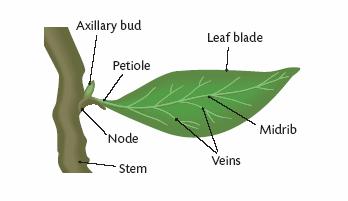
The main part of the leaf is called the blade. The blade is attached to the stem at the node. The attachment is made? with the petiole of the leaf. The petiole becomes the midrib of the leaf. The petiole, midrib, and veins contain the xylem and phloem that carry food and water.
VENATION
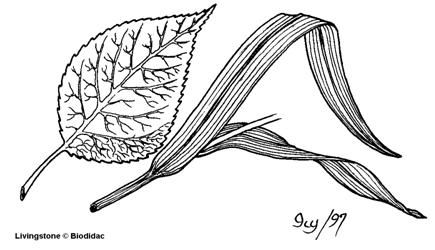
The pattern of veins on a leaf is called venation. There are 2 common types:
Parallel Venation- The veins run along side each other. This venation is typical in monocots.
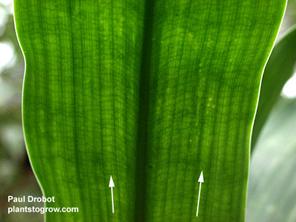
Net or Reticulate Venation- The veins form a branching network. This venation is typical in dicots.
A comparison of both venations:
FUNCTIONS OF LEAVES
Photosynthesis- The making of food in a plant. Through this process they obtain the food they need to live.
Gas exchange-they take in carbon dioxide and release oxygen.
Transpiration- They lose water through their leaves. As a result, fresh water enters the leaves through the midrib and veins.
Food storage.
Tissues in Flowering Plants
Plant tissues fall into three fundamental categories (among a few others): dermal tissue, ground tissue and vascular tissue.
Dermal Tissue
Dermal tissues generally occupy the “skin” layer of all plant organs. It is normally called epidermis. Its main function is protection of the plant. The epidermis of leaves is coated with a waxy cuticle to stop water loss.
Ground Tissue
This tissue occupies the space between the dermal tissues and the vascular tissues. These cells are much more than just filler, though. In roots the ground tissue may store sugars or starches to fuel the spring sap flow. In leaves, the ground tissue is that layer doing photosynthesis, the mesophyll. In many species ground tissues produce intracellular crystals that paralyse potential herbivores.
Vascular Tissues
The vascular tissues of higher plants (Kingdom Plantae) are divided into two sections: xylem and phloem. These 2 are found in the vascular bundles of plants.
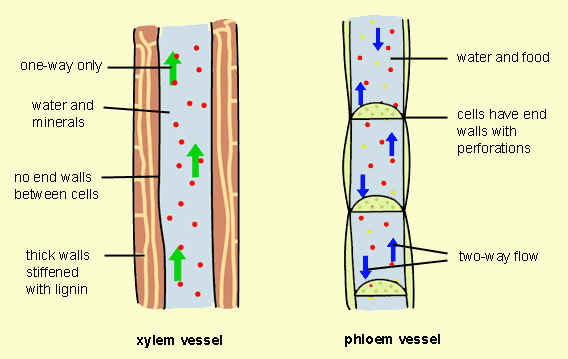
Xylem- Transports water and minerals throughout a plant. It also provides support for the plant. Xylem consists of 2 types of cells. Vessels and Tracheids.
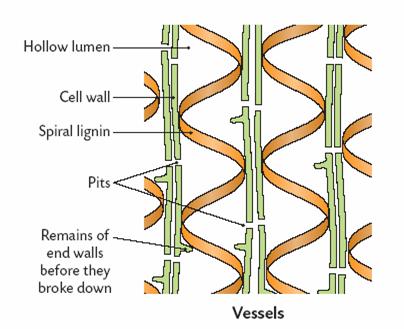
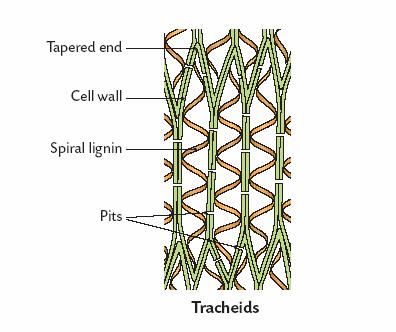
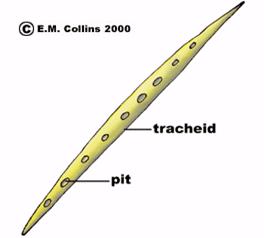
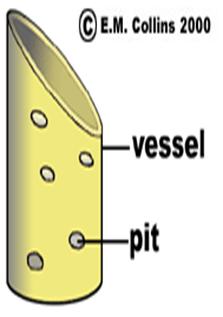
Both tracheids and vessels are tubes that allow water and dissolved minerals to pass throughout the plant. They also give support for the plant. They gain their strength because of lignin in their cell walls. The water and minerals go in and out of the tubes through the pits on the sides of the tubes. The vessels form continuous tubes while the tracheids are tapered at one end to allow one cell to overlap around another at their ends.
Tracheids are more primitive than vessels and are only found in coniferous trees such as pines.
Tracheid:
Vessel:
Xylem Summary
Tracheids and vessel members specialise in efficient water transport.
Long, narrow, dead cells with walls thickened and strengthened with lignin.
A series of vessel members forms a long continuous open tube called a xylem vessel.
Pits in the thickened walls allow easy water transfer to neighbouring cells.
Tracheids and vessel members also give great mechanical support to the plant.
Phloem
Phloem- Phloem carries food that is made in the leaves of the plant. It transports the food to the rest of the plant. Phloem is composed of sieve tubes and companion cells.
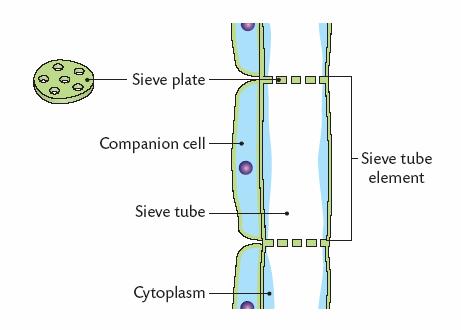
Sieve tubes are long, tubular structures. They when individual sieve tube cells called sieve tube elements, join end-to end. The end walls develop pores that enable materials to pass through. These end walls are called sieve plates. The walls are made of cellulose, not lignin. Therefore, phloem is not as strong as xylem. These tubes have lost their nuclei.
Each sieve tube element has a companion cell. These cells have a living cytoplasm and nucleus. Phloem, therefore, is a living tissue because of the living companion cell associated with each sieve tube element. Companion cells control the activities of the sieve tube element it is associated with.
PHLOEM SUMMARY:
Specialises in efficient transport of food.
Living cells but do not have a nucleus.
Long, narrow, thin walled living cells.
End walls are heavily perforated called a sieve plate.
A series of sieve elements is called a sieve tube.
Companion Cells
Assist the sieve element in food transport.
Live narrow cells with a prominent nucleus.
Its nucleus also controls the sieve element.
Dense cytoplasm particularly rich in mitochondria.
LOCATION OF PLANT TISSUES IN ROOTS, STEMS, AND LEAVES
The following section depicts the typical view of the dermal tissue, ground tissue, and vascular tissues (xylem and phloem in vascular bundles) in roots, stems, and leaves.
TS of Roots
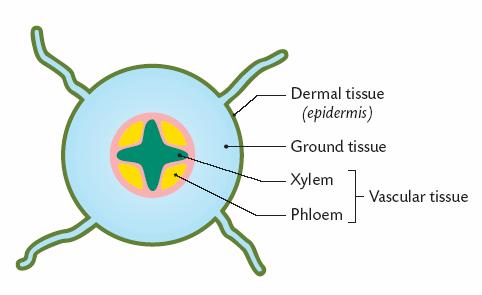
This diagram is of a typical dicot root:
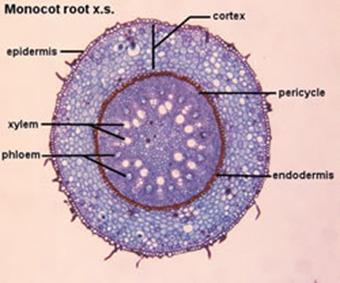
This is a diagram of a typical monocot root:
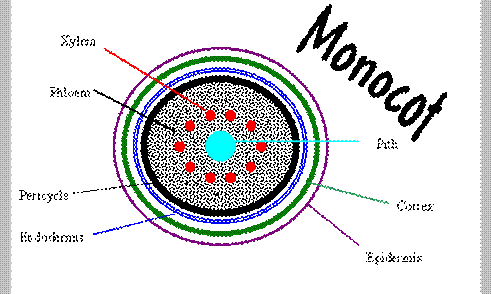
Dicot and monocots have different arrangements of root tissues. Notice that monocot roots have their xylem and phloem in a circular series around the root while dicots have them in one central location in the centre of the root.
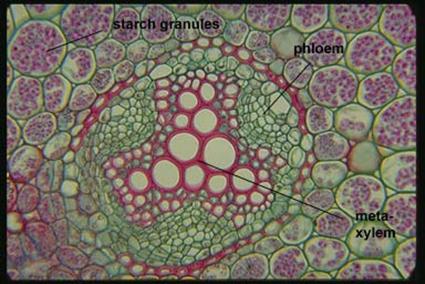
This is a photo of a dicot root using a microscope:
This is a photo of a monocot root using a microscope:
TS of Stems
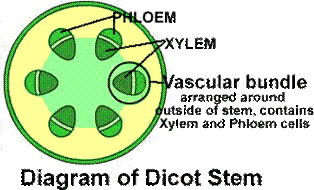
This is a diagram of a typical dicot stem:
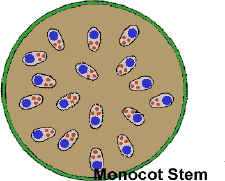
This is a diagram of a typical monocot stem:
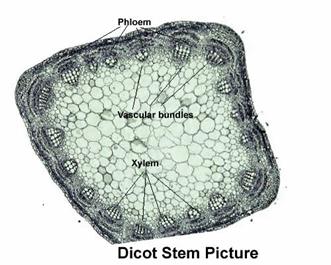
This is a photo of a dicot stem using a microscope:
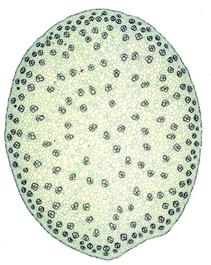
This is a photo of a monocot stem using a microscope:
Stems-Long Section:
Leaf Cross Section:
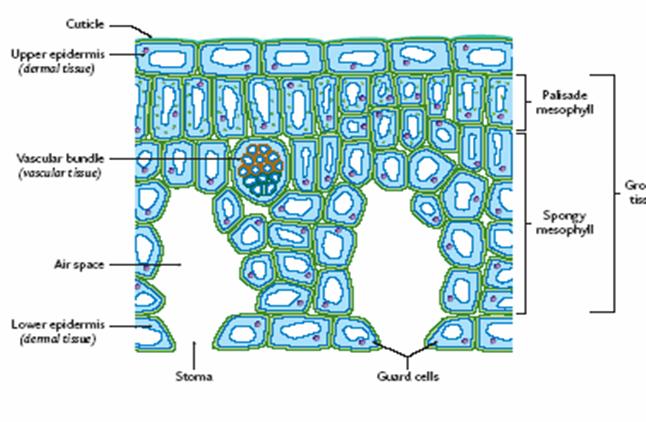
Dermal Tissue: outer single cell layer protective tissue.
Cuticle: layer of waterproof wax on the outer surface of the dermal tissue.
Ground Tissue: usually two layers, closely packed upper layer and loose lower layer photosynthetic tissue.
Air Spaces: rapid diffusion of carbon dioxide to the cells for photosynthesis.
Guard Cells: control the closing and opening of the stomatal pore.
Stomata: rapid entry of carbon dioxide into the leaf from the air.
The parts and functions of the leaf will be discussed on a separate web page.
MONOCOTS AND DICOTS
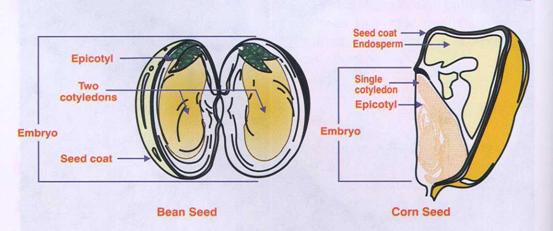
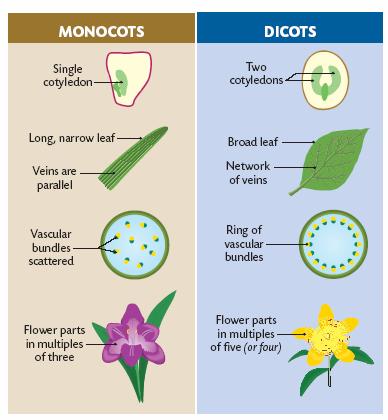
Monocots and dicots get their names because of the number of cotyledons present in their seeds. Cotyledons are leaves in the seed that provide food for the seed embryo before it is able to develop its own leaves and make its own food (after germination).
Monocots have one seed leaf or cotyledon while dicots have 2 seed leaves or cotyledons.
Bean seed is a dicot and a corn seed is a monocot:
There are quite a few differences between a monocot and a dicot plant. This chart displays their differences:
Mandatory Activity:
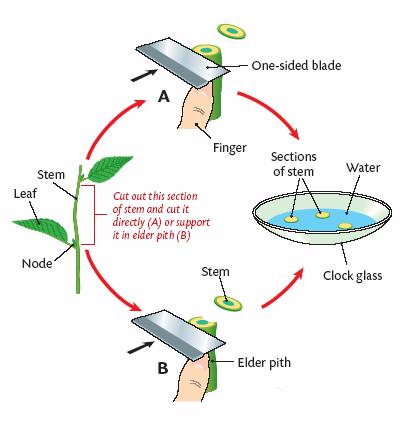
To prepare and examine a transverse section (TS) of a dicot stem: