Contents
Genetics is the science of heredity and how new life changes and varies in their characteristics. Sexual reproduction in humans involves 2 gametes; one male gamete, the sperm, and one female gamete, the egg.
As was discussed in the cell division webpage the gametes are haploid (n). When fertilisation occurs the resulting fertilised egg is diploid (2n) Genetic variations occur as a result of this union.
As was discussed in the heredity webpage the physical characteristics of organisms are developed as the protein builds up their bodies. These proteins are formed as a result of genes carried on chromosomes.
In genetics genes are represented by letters. There are usually 2 different types of the same gene; one is dominant and one is recessive. An example of this is: T is a gene for tall and t is a gene for short. The two versions of the same gene are called alleles. The two alleles are formed at the same position, or locus, on the chromosome.
REMEMBER: THE 2 ALLELES ARE GOTTEN FROM THE 2 GAMETES OF SEXUAL REPRODUCTION. THAT IS WHY THEY CAN DIFFER.
IN ASSEXUAL REPRODUCTION THE NEW LIFE IS ALWAYS IDENTICAL TO THE PARENT CELL BECAUSE THERE IS ONLY 1 PARENT.
Dominant genes will always prevent the recessive gene from working. If a person has 2 dominant alleles for tallness: T T then he will be tall. If a person has 1 dominant and I recessive allele for tallness: T t then he will be tall. The only way the recessive gene will be expressed is if he has 2 recessive alleles for short: t t then he will be short.
If the pair of genes controlling the characteristic has identical alleles, TT or tt, we call it a homozygous pair of genes. If the pair of genes controlling the characteristic are different alleles, Tt or Cr, or Cw we call it a heterozygous pair of genes.
When we express the genotype of a characteristic we state the pair of alleles. Genotype examples are TT, Tt, tt, BB, Bb, bb, etc.
When we state the physical characteristic expressed by the genotype we are stating is phenotype. The phenotype for TT is tall while the phenotype for tt is short. These phenotypes could vary because of environment effects. This is especially true in terms of genotypes and phenotypes for intelligence. The upbringing, environment, and education experiences greatly affect the phenotype.
GENETIC CROSSES
REMEMBER: THE 2 ALLELES ARE GOTTEN FROM THE 2 GAMETES OF SEXUAL REPRODUCTION. THAT IS WHY THEY CAN DIFFER.
When working on genetic crosses you must state the capital letter which represents the dominant allele and the small letter that represents the recessive allele.
The following is an example of how to work out genetic crosses:
|
A is a dominant characteristic. |
a is a |
|
This bird has two genes for red feathers. Its genotype is AA. Its phenotype is RED |
This bird has two genes for blue feathers. Its genotype is aa. Its phenotype is BLUE |
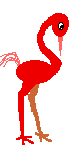
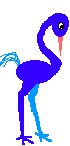
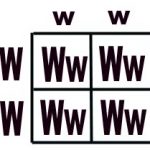
This Punnett Square shows how we can diagram the genes.
The orange bird has two dominant A genes. We put two A s along the top of the square.
The blue bird has two recessive a genes. We put two a s down along the left side of the square.
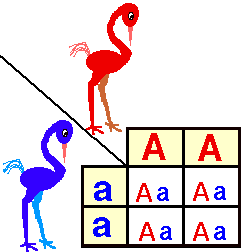
All the offspring have the genes Aa.
Dominant and Recessive Genes
They will all have orange feathers (phenotype), but will carry a recessive gene for blue feathers (genotype).The progeny are the offspring produced.This is called the F1 generation progeny.
Now suppose that two individuals from the F1 generation become parents. Here they are!
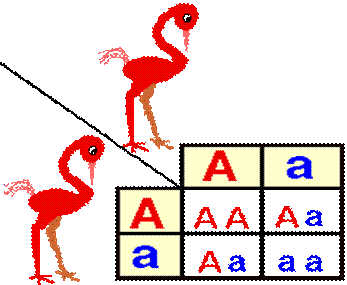
The baby birds are called the F2 generation. You can see how their genes work out. The offspring are coded in the squares. One bird will be orange with two AA genes.
Two birds will be orange with genes coded Aa.
One bird will be blue and will have two recessive aa genes. Individual nests of birds may not turn out exactly like this, but if there are many baby birds, they will work out genetically with the ratios 1:2:1.
Genotype: 1 AA, 2 Aa, 1 aa
Phenotype: 3 orange feathers, 1 blue feathers
Incomplete Dominance
Incomplete dominance is the situation where two different alleles are equally dominant. When this occurs the heterozygous genotype that is produced is an intermediate phenotype (blend) between the two respective homozygous genotypes. This is also called codominance.
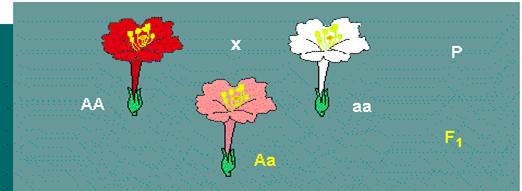
In this example AA genotypes have red, Aa genotypes pink and aa genotypes whitish flowers. Note that the heterozygous genotype Aa is a blend of red and white.
Note: This is the F1 generation.
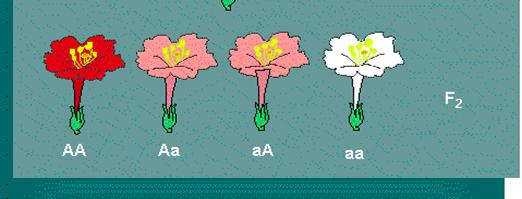
In the F2 generation two pink flowers will produce 2 pink phenotypes, 1 red phenotype, and 1 white phenotype:
Pedigree Studies
A pedigree is a diagram showing the genetic history of a group of related organisms.
A pedigree showing the occurrence of a recessive trait in three generations of a family:
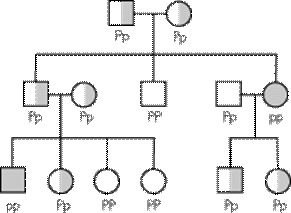
Circles in a pedigree represent females and squares represent males. A horizontal line between a circle and a square indicates a marriage or partnership. Vertical lines indicate the children from the marriage or partnership. In this activity, a filled-in circle or square shows that the individual has both alleles for the trait. A half-filled-in circle or square indicates that the individual has one recessive allele for the trait.
Sex Determination
Our cells have 46 chromosomes. There are 23 pairs. Remember, we get 23 from our mother and 23 from our father. We have 22 pairs of chromosomes called autosomes. These are the chromosomes that control our body growth, enzymes, etc. We have 1 pair of sex chromosomes.
If the person is a male that pair is composed of an X and a Y chromosome. The male’s genotype is XY.
If the person is a female she will have a sex chromosome composed of 2 Y chromosomes. The female’s genotype is XX.
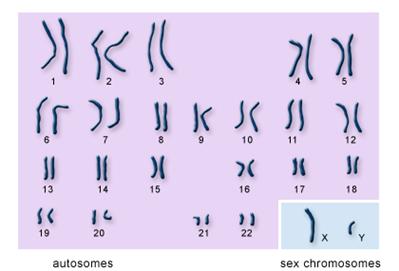
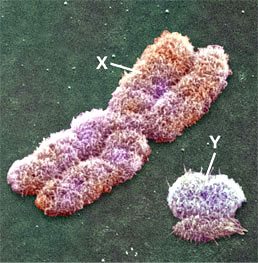
The Punnett Square for the fertilisation of a sperm and an egg is:
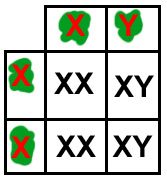
If the child has a genotype of XX then it becomes a girl. If the child has a genotype of XY then it becomes a boy.
As you can see the ratio of males to females is 1:1.
Review Questions
1. Which of the following is a possible abbreviation for a genotype?
A. BC
B. Pp
C. Ty
D. fg
2. What is the best way to determine the phenotype of the feathers on a bird?
A. analyze the bird’s DNA (genes)
B. look at the bird’s feathers
C. look at the bird’s beak
d. examine the bird’s droppings
3. Which of the following pairs is not correct?
A. kk = hybrid
B. hybrid = heterozygous
C. heterozygous = Hh
D. homozygous = RR
4. The genes present in an organism represent the organism’s __________.
A. genotype
B. phenotype
C. physical traits
5. Which choice represents a possible pair of alleles?
A. k & t
B. K & T
C. K & k
D. K & t
6. How many alleles for one trait are normally found in the genotype of an organism?
A. 1
B. 2
C. 3
D. 4
7. Which statement is not true?
A. genotype determines phenotype
B. phenotype determines genotype
C. a phenotype is the physical appearance of a trait in an organism
D. alleles are different forms of the same gene
8. In the cross Yy x Yy, what percent of offspring would have the same phenotype as the parents?
A. 25%
B. 50%
C. 75%
D. 100%
9. In a certain plant, purple flowers are dominant to red flowers. If the cross of two purple-flowered plants produces some purple-flowered and some red-flowered plants, what is the genotype of the parent plants?
A. PP x Pp
B. Pp x Pp
C. pp x PP
D. pp x pp
Base questions #10-13 on the following information:
A white-flowered plant is crossed with a pink-flowered plant. All of the F1 offspring from the cross are white.
10. Which phenotype is dominant?
11. What are the genotypes of the original parent plants?
12. What is the genotype of all the F1 offspring?
13. What would be the percentages of genotypes & phenotypes if one of the white F1 plants is crossed with a pink-flowered plant?
14. The outward appearance (gene expression) of a trait in an organism is referred to as:
A. genotype
B. phenotype
C. an allele
D. independent assortment
15. In the homologous chromosomes shown in the diagram, which is a possible allelic pair?
A. cD
B. Ee
C. AB
D. ee
16. The phenotype of a pea plant can best be determined by:
A. analyzing its genes
B. looking at it
C. crossing it with a recessive plant
D. eating it
Review Answers
CORRECT ANSWERS FOR Q’S 1-9 ARE UNDERLINED
1. Which of the following is a possible abbreviation for a genotype?
A. BC
B. Pp – genotypes are made up of 2 of the same letter (either 2 capital, 2 lowercase, or one of each)
C. Ty
D. fg
2. What is the best way to determine the phenotype of the feathers on a bird?
A. analyze the bird’s DNA (genes)
B. look at the bird’s feathers – “phenotype of the feathers” means what the feathers look like, so look at them
C. look at the bird’s beak
d. examine the bird’s droppings
3. Which of the following pairs is not correct?
A. kk = hybrid – Kk would be hybrid (one capital, one lowercase of the same letter)
B. hybrid = heterozygous
C. heterozygous = Hh
D. homozygous = RR
4. The genes present in an organism represent the organism’s __________.
A. genotype – X
B. phenotype
C. physical traits
5. Which choice represents a possible pair of alleles?
A. k & t
B. K & T
C. K & k – allele means 2 forms of the same gene. so this choice shows 2 forms of the same letter K or k
D. K & t
6. How many alleles for one trait are normally found in the genotype of an organism?
A. 1
B. 2 – one allele is inherited from each parent
C. 3
D. 4
7. Which statement is not true?
A. genotype determines phenotype – (note that the environment does play a role in influencing phenotype too)
B. phenotype determines genotype – X
C. a phenotype is the physical appearance of a trait in an organism
D. alleles are different forms of the same gene – (see question #5)
8. In the cross Yy x Yy, what percent of offspring would have the same phenotype as the parents?
A. 25%
B. 50%
C. 75% – in the completed p-square, 3 of 4 boxes will have at least 1 “Y”, producing the dominant phenotype (same as parents)
D. 100%
9. In a certain plant, purple flowers are dominant to red flowers. If the cross of two purple-flowered plants produces some purple-flowered and some red-flowered plants, what is the genotype of the parent plants?
A. PP x Pp
B. Pp x Pp – for any offspring to be recessive, each parent MUST have at least one “p”
C. pp x PP – only one parent is purple, this CAN’T be an answer
D. pp x pp – neither parent is purple, this CAN’T be an answer
Base questions # 10-13 on the following information:
A white-flowered plant is crossed with a pink-flowered plant. All of the F1 offspring from the cross are white.
10. Which phenotype is dominant? White.
11. What are the genotypes of the original parent plants? WW (pure white) x ww (pink)
12. What is the genotype of all the F1 offspring? Ww (white)
13. What would be the percentages of genotypes & phenotypes if one of the white F1 plants is crossed with a pink-flowered plant?
50% heterozygous white & 50% homozygous recessive pink.
The cross for this question would be “Ww (white F1) x ww (pink)”.
The alleles of the white parent are above the columns & those of the pink parent are in front of the rows. 2 of 4 boxes (50%) are “Ww”, which is heterozygous & would have the dominant trait (white). The other 2 of 4 boxes (50%) are “ww”, which is homozygous recessive & would have the recessive trait (pink).
14. The outward appearance (gene expression) of a trait in an organism is referred to as:
A. genotype
B. phenotype – X
C. an allele
D. independent assortment
15. In the homologous chromosomes shown in the diagram, which is a possible allelic pair?
A. cD
B. Ee- a possible allelic pair but NOT SHOWN IN THE DIAGRAM, so this CAN’T be an answer
C. AB
D. ee – an “allelic pair” is always two forms of the same letter. In this example they are two lowercase “e’s”.
16. The phenotype of a pea plant can best be determined by:
A. analyzing its genes
B. looking at it – X
C. crossing it with a recessive plant
D. eating it