Contents
As we have studied in our Nervous System study animals respond to stimuli using electrical and chemical signals. We have also learned that chemical messengers in our Endocrine System are used to accomplish life’s needs.
Plants also have the means to respond to their environment in order to successfully live. They use chemicals similar to the endocrine system to accomplish this. This web page will examine these plant responses.
The Regulation of Growth
Plants’ growth is controlled by many factors. Some of the factors are environmental and climatic while others come from within the plants themselves.
External Environmental Factors
Some external factors that regulate the growth of plants are light intensity, day length, gravity, and temperature.
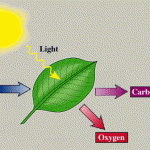
Light- Light, obviously affects the plants ability to grow because light is needed for photosynthesis. Through photosynthesis the plant makes its energy carrying molecules. It is also needed for the production of chlorophyll.
Day Length- Day length causes the plants to flower. Many other roles of day length are being studied such as fruit and seed germination, dormancy, and leaf loss.
Gravity- Gravity causes roots to grow down toward the soil and roots to grow up away from the source of gravity.
Temperature- Temperature affects the rate of enzyme reaction. Higher temperature, to a point, is best for plant growth while low temperatures are needed for some plants to flower.
Tropisms
A tropism is a biological phenomenon, indicating growth or turning movement of a biological organism, usually a plant, in response to an environmental stimulus. In tropisms, this response is dependent on the direction of the species. The word tropism comes from the Greek trope (“to turn” or “to change”). Tropisms are usually named for the stimulus involved and may be either positive (towards the stimulus) or negative (away from the stimulus).
Phototropism
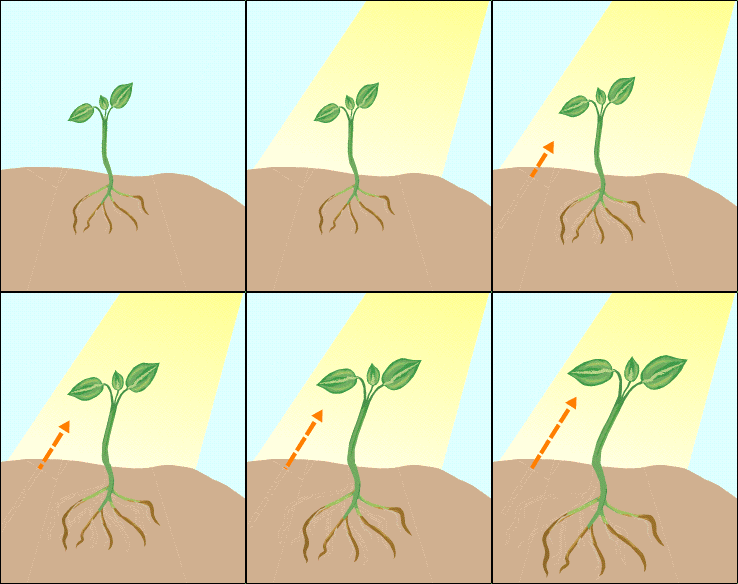
Phototropism is the growth response of a plant in response to light direction. Different parts of a plant exhibit different reactions to light. Stems exhibit positive phototropism while most roots exhibit negative phototropism.
Geotropism
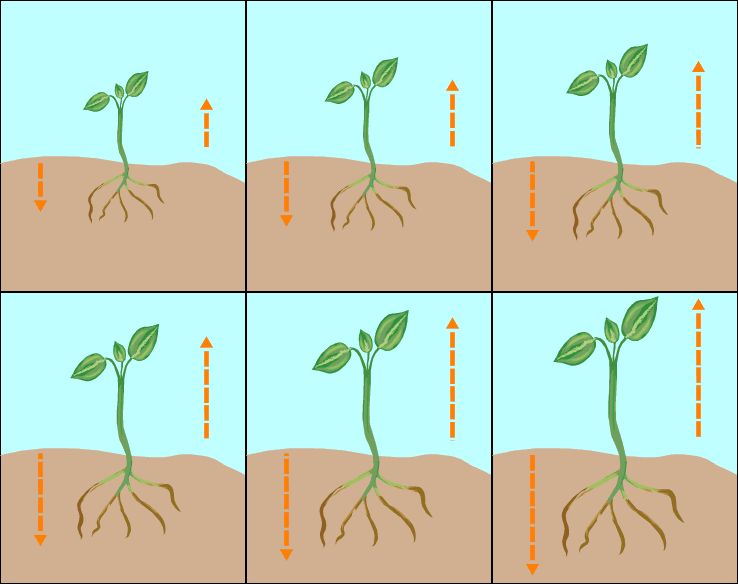
Geotropism is the growth response of a plant in response to gravity. Roots exhibit positive geotropism while stems and leaves exhibit negative geotropism.
Thigmotropism
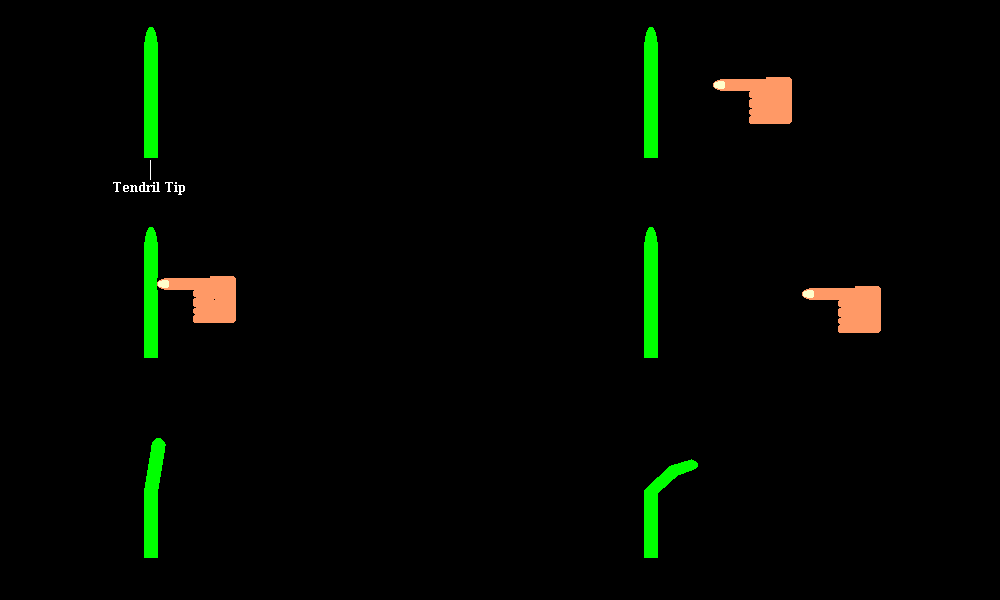
Thigmotropism is the growth response of a plant to physical contact (touch). Plants that cling to physical structures such as walls exhibit positive thigmotropism.

Hydrotropism
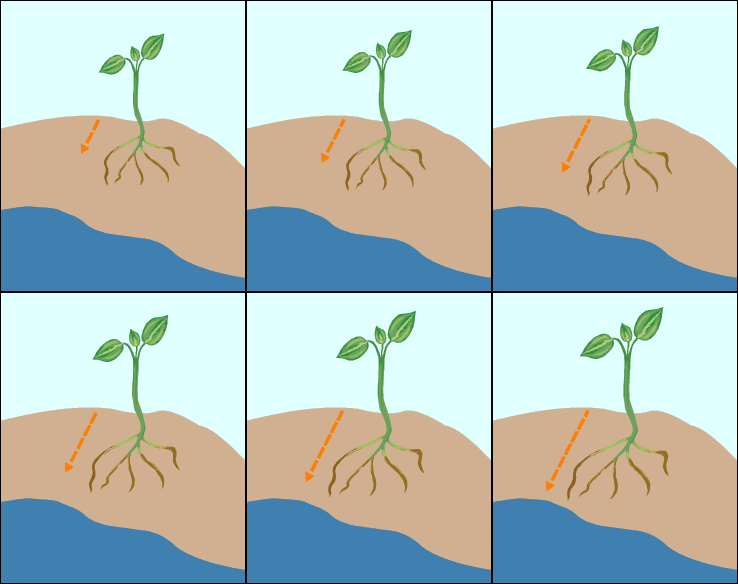
Hydrotropism is the growth response of a plant to water. Roots exhibit positive hydrotropism.
Chemotropism is the growth response of a plant to a particular chemical. Roots grow toward useful minerals in the soil but away from acids.
Growth Regulators
Growth regulators are chemicals that control the growth of a plant. Some of these are growth promoters while others are growth inhibitors.
Growth Promoters
Auxins- Auxins are chemicals that are produced at the meristems, young leaves, and seeds of plants. The most important auxin is indoleacetic acid (IAA). Auxins have a role in the following:
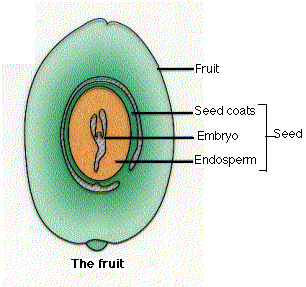
Development of the embryo- From the very first mitotic division of the zygote, auxins guide the patterning of the embryo into the parts that will become the organs of the plant:
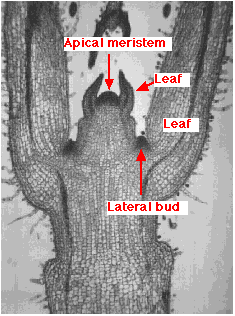
Leaf formation- The formation of new leaves in the apical meristem is initiated by the accumulation of auxin. Already-developing leaves deplete the surrounding cells of auxin so that the new leaves do not form too close to them. In this way, the characteristic pattern of leaves in the plant is established.
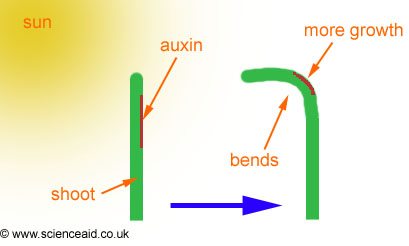
Phototropism- Plant shoots display positive phototropism: when illuminated from one direction, the shoot proceeds to grow in that direction.
Geotropism- Geotropism is a plant growth response to gravity. Plant shoots display negative geotropism: when placed on its side, a plant shoot will grow up. Roots display positive geotropism: they grow down.
Apical dominance- Growth of the apical bud usually inhibits the development of the lateral buds on the stem beneath. This phenomenon is called apical dominance. If the apical bud of a plant is removed, the inhibition is lifted, and lateral buds begin growth. Gardeners use this principle by pruning the apical buds of ornamental shrubs, etc. The release of apical dominance enables lateral branches to develop and the plant becomes bushier. The process usually must be repeated because one or two laterals will eventually outstrip the others and apical dominance will result again. Apical dominance seems to result from the downward transport of auxin produced in the apical meristem. In fact, if the apical meristem is removed and IAA applied to the stump, inhibition of the lateral buds is maintained.
Fruit development- Pollination of the flowers of angiosperms initiates the formation of seeds. As the seeds mature, they release IAA to the surrounding flower parts, which develop into the fruit that covers the seeds. Some commercial growers deliberately initiate fruit development by applying IAA to the flowers. Not only does this ensure that all the flowers will “set” fruit, but it also maximizes the likelihood that all the fruits will be ready for harvest at the same time. This process develops seedless fruit.
Root initiation- IAA in epidermal cells of the root initiates the formation of lateral or secondary roots. Auxin also stimulates the formation of adventitious roots in many species. Adventitious roots grow from stems or leaves rather than from the regular root system of the plant. Horticulturists may propagate desirable plants by cutting pieces of stem and placing them base down in moist soil. Eventually adventitious roots grow out at the base of the cutting. The process can often be hastened by treating the cuttings with a solution or powder containing a synthetic auxin.
Cell elongation- Auxins cause the cells of plants to elongate because they soften the cell walls. They also stimulate enzymes that cause cell elongation.
Growth Inhibitors
The auxin ethane is a gas. It is made in the nodes of stems, in ripe fruits, and in decaying leaves. This auxin causes leaves and fruits to fall from trees. It causes a special layer of cells – the abscission layer – to form at the base of the petiole or fruit stalk. Soon the petiole or fruit stalk breaks free at this point and the leaf or fruit falls to the ground. It also causes fruits to colour, flavour, and ripen. It also causes plants to age.
Abscisic acid (ABA)
Unlike animals, plants cannot flee from potentially harmful conditions like drought the approach of winter. They must adapt or die. The plant hormone abscisic acid (ABA) is the major player in a plant’s responses to stress.
Bud dormancy
ABA mediates the conversion of the apical meristem into a dormant bud. The newly developing leaves growing above the meristem become converted into stiff bud scales that wrap the meristem closely and will protect it from mechanical damage and drying out during the winter.
ABA in the bud also acts to enforce dormancy so if an unseasonably warm spell occurs before winter is over, the buds will not sprout prematurely. Only after a prolonged period of cold or the lengthening days of spring (photoperiodism) will bud dormancy be lifted.
Seed maturation and dormancy
Seeds are not only important agents of reproduction and dispersal, but they are also essential to the survival of annual and biennial plants. These angiosperms die after flowering and seed formation is complete. ABA plays a role in seed maturation, at least in some species, and also enforces a period of seed dormancy. As we saw for buds, it is important the seeds not germinate prematurely during unseasonably mild conditions prior to the onset of winter or a dry season. ABA in the seed enforces this dormancy. Not until the seed has been exposed to a prolonged cold spell and/or sufficient water to support germination is dormancy lifted.
Closing of stomata
Some 90% of the water taken up by a plant is lost in transpiration. Most of this leaves the plant through the pores – called stomata – in the leaf. A pair of guard cells flanks each stoma. When the guard cells are turgid, the stoma is open. When turgor is lost, the stoma closes. ABA is the hormone that triggers closing of the stomata when soil water is insufficient to keep up with transpiration.
IAA’s Role in Phototropism
IAA is produced in the meristems of the stem. The auxin diffuses down the shady side of a stem and not the sunny side. As a result, the cells on the shady side elongate more than the sunny side and the stem bends toward the sun.
Commercial Applications
Plant hormones have many commercial uses, relating to agriculture and flower growing.
Rooting Powder: Naphthylacetic acid (NAA) is used to stimulate root formation of plant cuttings.
Cytokinin: An auxin, which is used in tissue culturing. Pieces of a plant can be grown into a new plant. First a callus forms. This is a group of cells. Auxins are then used in varying concentrations to produce the parts of the plant.
Ethelene: Ethelene promotes the ripening of bananas for the market.
Auxins are used as selective weed killers. They reduce competition and so promote crop growth.
Production of seedless fruits e.g. oranges.
Specific Plant Adaptation for Various Habitats
The Desert
The desert is very dry and often hot. Annual rainfall averages less than 10 inches per year, and that rain often comes all at the same time. The rest of the year is very dry. There is a lot of direct sunlight shining on the plants. The soil is often sandy or rocky and unable to hold much water. Winds are often strong, and dry out plants. Plants are exposed to extreme temperatures and drought conditions. Plants must cope with extensive water loss.
Desert Plant Adaptations
Some plants, called succulents, store water in their stems or leaves;
Some plants have no leaves or small seasonal leaves that only grow after it rains. The lack of leaves helps reduce water loss during photosynthesis. Leafless plants conduct photosynthesis in their green stems.
Long root systems spread out wide or go deep into the ground to absorb water;
Some plants have a short life cycle, germinating in response to rain, growing, flowering, and dying within one year. These plants can evade drought.
Leaves with hair help shade the plant, reducing water loss. Other plants have leaves that turn throughout the day to expose a minimum surface area to the heat.
Spines to discourage animals from eating plants for water;
Waxy coating on stems and leaves help reduce water loss.
Flowers that open at night lure pollinators who are more likely to be active during the cooler night.
Slower growing requires less energy. The plants don’t have to make as much food and therefore do not lose as much water.
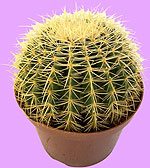
This cactus displays several desert adaptations: it has spines rather than leaves and it stores water in its stem:
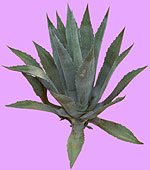
This plant has a waxy coating on its leaves:
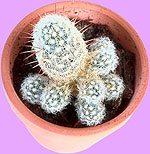
This cactus displays light-colour hair that helps shade the plant:
The Temperate Grasslands
The temperate grasslands, also called prairie, feature hot summers and cold winters. Rainfall is uncertain and drought is common. The temperate grasslands usually receive about 10 to 30 inches of precipitation per year. The soil is extremely rich in organic material due to the fact that the aboveground portions of grasses die off annually, enriching the soil. The area is well suited to agriculture, and few original prairies survive today.
Temperate Grassland (Prairie) Plant Adaptations
During a fire, while above-ground portions of grasses may perish, the root portions survive to sprout again
Some prairie trees have thick bark to resist fire
Prairie shrubs readily resprout after fire
Roots of prairie grasses extend deep into the ground to absorb as much moisture as they can
Extensive root systems prevent grazing animals from pulling roots out of the ground
Prairie grasses have narrow leaves which lose less water than broad leaves
Grasses grow from near their base, not from tip, thus are not permanently damaged from grazing animals or fire
Many grasses take advantage of exposed, windy conditions and are wind pollinated
Soft stems enable prairie grasses to bend in the wind
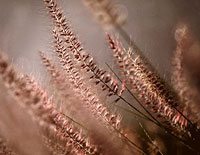
Soft stems enable prairie grasses to bend in the wind. Narrow leaves minimize water loss:
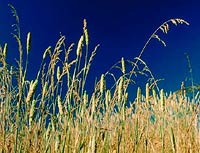
Many grasses are wind pollinated and are well suited to the exposed, windy conditions of the grasslands:
The Tropical Rainforest
The tropical rainforest is hot and it rains a lot, about 80 to 180 inches per year. This abundance of water can cause problems such as promoting the growth of bacteria and fungi, which could be harmful to plants. Heavy rainfall also increases the risk of flooding, soil erosion, and rapid leaching of nutrients from the soil (leaching occurs when the minerals and organic nutrients of the soil are “washed” out of the soil by rainfall as the water soaks into the ground). Plants grow rapidly and quickly use up any organic material left from decomposing plants and animals. This results is a soil that is poor. The tropical rainforest is very thick, and not much sunlight is able to penetrate to the forest floor. However, the plants at the top of the rainforest in the canopy must be able to survive 12 hours of intense sunlight every day of the year. There is a great amount of diversity in plant species in the tropical rainforest.
Tropical Rainforest Plant Adaptations
Drip tips and waxy surfaces allow water to run off, to discourage growth of bacteria and fungi
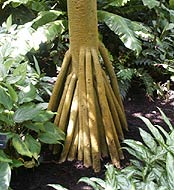
Buttresses and prop and stilt roots help hold up plants in the shallow soil
Some plants climb on others to reach the sunlight
Some plants grow on other plants to reach the sunlight
Flowers on the forest floor are designed to lure animal pollinators since there is relatively no wind on the forest floor to aid in pollination
Smooth bark and smooth or waxy flowers speed the run off of water
Plants have shallow roots to help capture nutrients from the top level of soil.
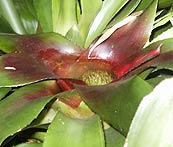
Many bromeliads are epiphytes (plants that live on other plants); instead of collecting water with roots they collect rainwater into a central reservoir from which they absorb the water through hairs on their leaves
Epiphytic orchids have aerial roots that cling to the host plant, absorb minerals, and absorb water from the atmosphere
Drip-tips on leaves help shed excess water:
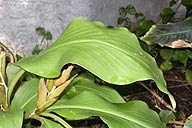
Prop roots help support plants in the shallow soil:
Some plants collect rainwater into a central reservoir:
The Temperate Rainforest
The temperate rain forest features minimal seasonal fluctuation of temperature: the winters are mild and the summers cool. The temperate rain forest receives a lot of precipitation, about 80 to 152 inches per year. Condensation from coastal fogs also add to the dampness. The soil is poor in nutrients. Large evergreen trees, some reaching 300 feet in height, are the dominant plant species.
Temperate Rain Forest Plant
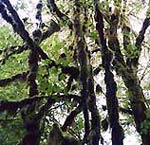
Epiphytes such as mosses and ferns grow atop other plants to reach light.
Cool temperatures lead to slow decomposition but seedlings grow on “nurse logs” to take advantage of the nutrients from the decomposing fallen logs.
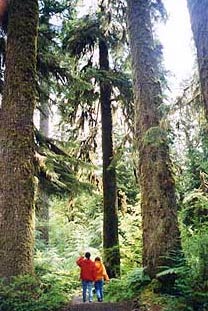
Trees can grow very tall due to amount of precipitation.
Epiphytes live on other plants to reach the sunlight:
Trees can grow very tall in this very moist environment:
Fun Links
Take a break from studying and play some fantasy football! Learn how at Fantasy Footballer.