Contents
Respiration is the process by which cells convert food in energy. The food from which energy is released is mainly glucose. There are 2 types of respiration: aerobic and anaerobic respiration.
AEROBIC RESPIRATION
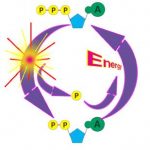
Aerobic respiration uses oxygen to get the energy from food. Living things that use aerobic respiration are called aerobes. As a result of aerobic respiration ATP is released from food. The energy released is used by the cell to perform its functions. Enzymes are used in this process.
The basic chemical equation for respiration is:
C6H12O6 + 6 O2 —————-> 6 CO2 + 6 H2O + ENERGY
THE STAGES OF RESPIRATION (ordinary level)
There are 2 stages involved in respiration:
Stage 1: Glycolysis
Glycolysis takes place in the cytosol. The cytosol is the clear portion of the cytoplasm. Here is where the enzymes needed for stage 1 are located. This process does not need oxygen.
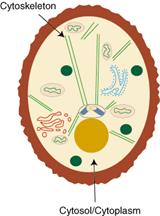
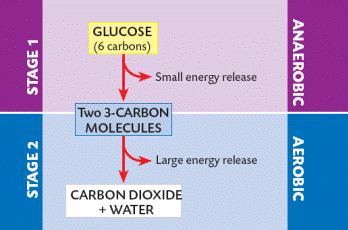
The process of glycolysis functions to split a glucose molecule into two 3-carbon molecules called pyruvic acid (C3H4O3). This releases a small amount of ATP but most of the ATP is still contained in the 3-Carbon molecules.
Stage 2: The Krebs Cycle
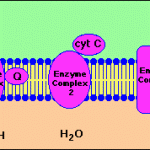
Stage 2 requires oxygen and takes place in the mitochondia of the cell.
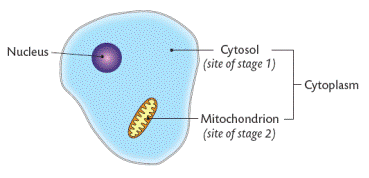
In stage 2 the 3-Carbon molecules (pyruvic acid) breaks apart to form carbon dioxide and water. This releases a great deal of ATP for the cell to use.
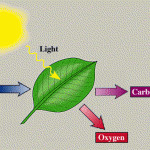
A generalised view of respiration:
ANAEROBIC RESPIRATION (ordinary level)
In anaerobic respiration oxygen is not needed although it can take place in the presence of oxygen. In anaerobic respiration glycolysis takes place. The 3-carbon molecules (pyruvic acid) are then converted into other products. Anaerobic respiration is also known as fermentation.
Two products of anaerobic respiration are lactic acid and alcohol.
Lactic acid is produced in some bacteria, fungi, and muscle tissue.
Pyruvic Acid is changed into lactic acid + small amount of energy.
Examples of Lactic Acid:
Bacteria causing milk to sour
Bacteria change cabbage to sauerkraut
Bacteria changing dairy products to cheese and yoghurt
Build up of lactic acid in muscles (because of lack of oxygen) causing cramps and stiffness
ALCOHOL FERMENTATION
Alcohol fermentation occurs in some bacteria, yeasts, and in plants deprived of oxygen. Again the pyruvic acid formed by glycolysis is changed. Here it is changed into ethanol ethyl alcohol) and carbondioxide.
Pyruvic Acid is changed into ethanol + small amount of energy
Uses of Alcohol Fermentation
Baking: the carbon dioxide causes the dough to rise
Beer and Wine production
Summary of Anaerobic Respiration:

Biotechnology: (See batch processing and continuous flow processing by clicking on the Bacteria Webpage on the Homepage)
Immobilised Cells: Just as enzymes are immobilised for commercial uses bacteria, fungi, and yeasts are also immobilised for production of products. See the enzyme webpage to review immobilisation techniques.